01Real-world example
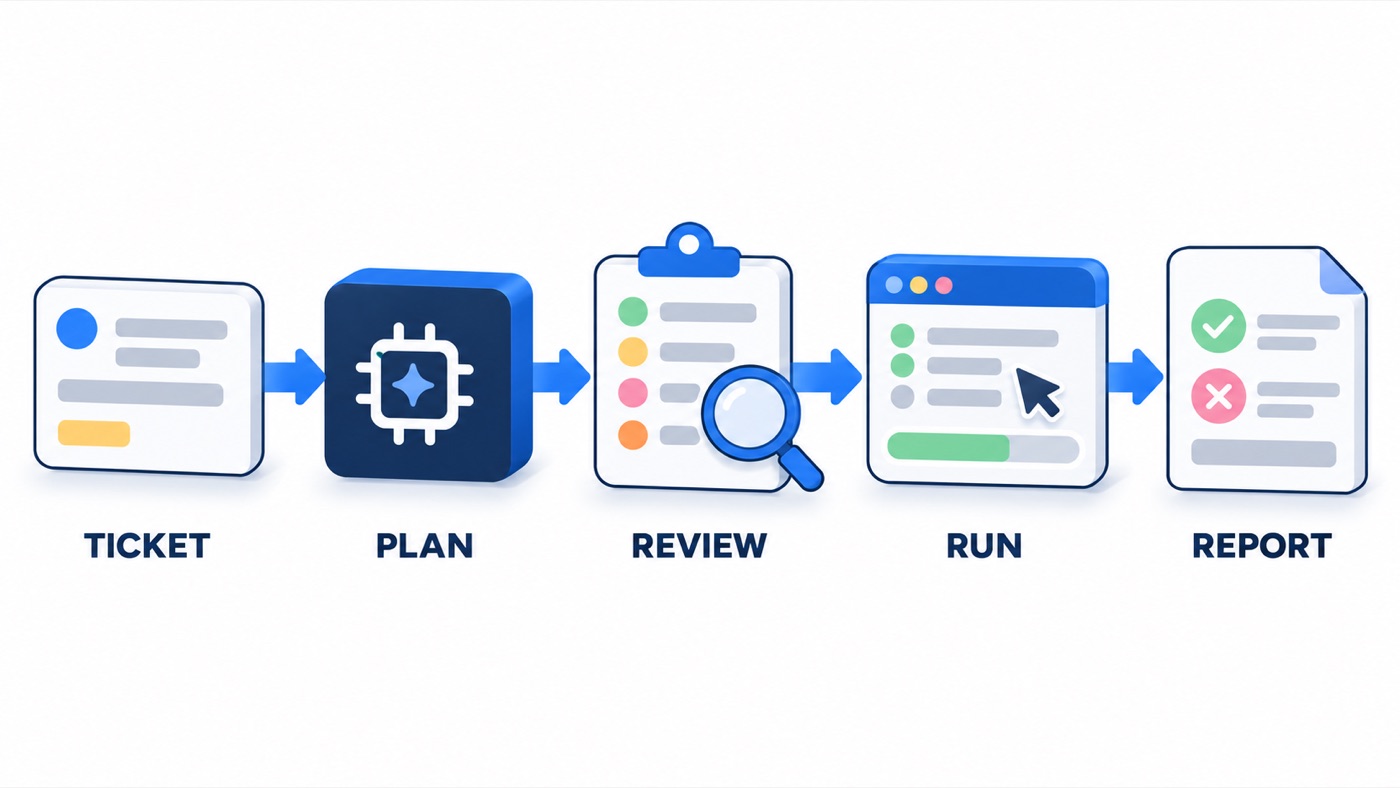
Give it a Jira ticket. It plans the tests, runs them in a browser, and explains what failed and why.
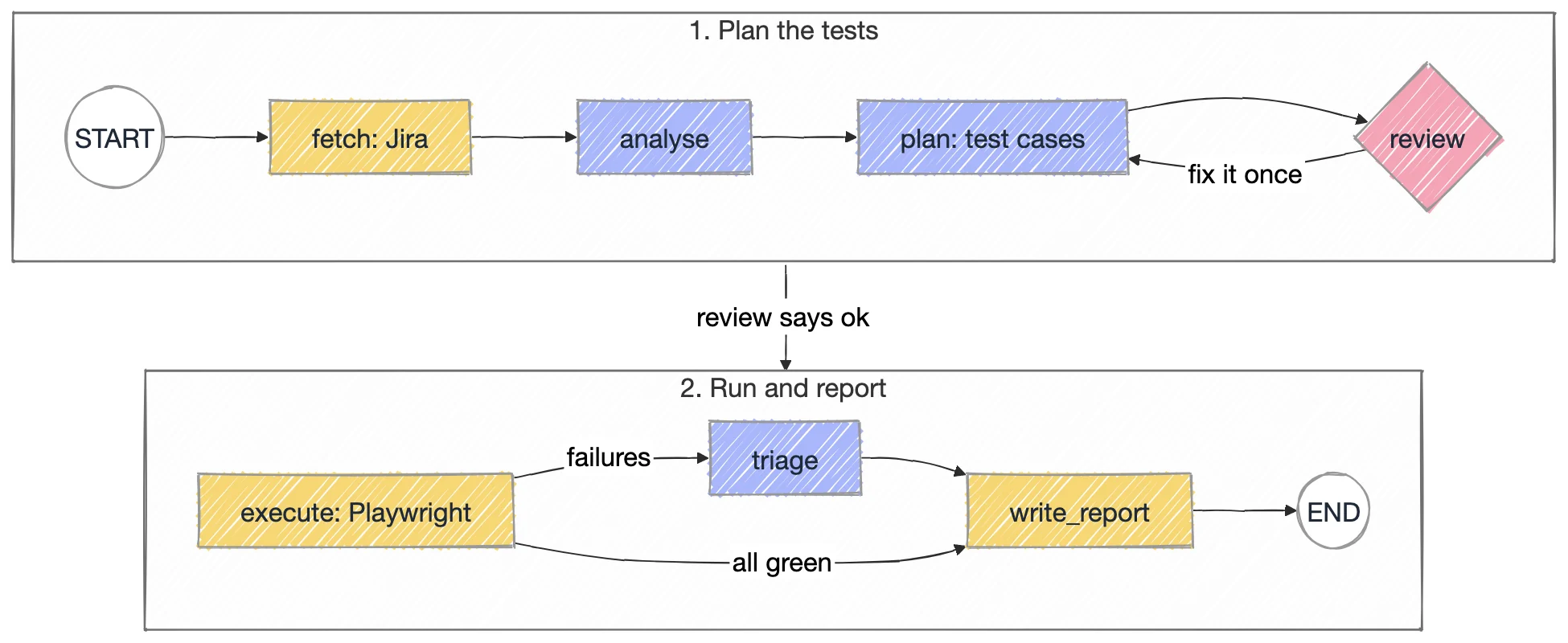
fetch reads the Jira ticket over REST, or fixtures/VWO-105.json when no token is set; analyse lists features, acceptance criteria and risks.plan writes 5 to 8 cases as JSON steps with structured output (method="json_schema", low reasoning effort, three retries).review checks every step against the real TTACart page map, then an LLM reviews like a senior QA; problems send the plan back once (MAX_REVIEWS = 2).execute runs only the cases that pass executor.problems(); the rest are skipped with the reason. LLM-written steps are untrusted input.triage labels each failure product_bug, test_bug, environment or flaky; write_report writes one HTML file and can email it. worker.py polls JQL and labels each ticket qa-auto-done.cd chapter_18_LangGraph/capstone
python pipeline.py VWO-105 passed TC-01 Login success for standard_user redirects to inventory
passed TC-03 Add then remove a product updates cart badge correctly
passed TC-04 Sorting options display correct product order
failed TC-05 Product detail page add/remove syncs with cart badge
passed TC-06 Checkout information validation errors
failed TC-07 Reset App State clears cart and remove buttons
skipped TC-02 Locked out user sees error and stays on login page
skipped TC-08 Logout clears session and returns to login page
report: reports/VWO-105-20260928-184544/report.htmlchapter_18_LangGraph/.env.sample to .env and add a free Groq key from console.groq.com.Work in chapter_18_LangGraph/capstone. Change one thing, run it, and compare with the expected result.
In capstone/ run python check.py. It serves a fake TTACart on localhost.
all checks passed, with no LLM, Jira or internet.Open plan.json in the latest reports/ folder and find a skipped case.
data-test id that is not in the app map.Open report.html, pick a failed case and compare its triage label with its screenshot.
The exact file from the course repo, plus the output it printed when this page was written.
"""Capstone: Jira requirement -> analysis -> test plan + cases -> review -> run on TTACart
-> failure triage -> HTML report. One LangGraph, seven nodes.

    python pipeline.py VWO-105           # fetch, plan, run, report
    python pipeline.py VWO-105 --send    # ...and email the report
"""
import json
import os
import sys
from datetime import datetime
from pathlib import Path
from typing import Literal, TypedDict

from langgraph.graph import END, START, StateGraph
from pydantic import BaseModel, Field, field_validator

sys.path.insert(0, str(Path(__file__).resolve().parents[1] / "src" / "chapters"))
from llm import get_llm  # noqa: E402  chapter 18's Groq helper, reads chapter_18_LangGraph/.env

import executor, jira, report  # noqa: E402

RUNS = Path(__file__).parent / "reports"
# Low reasoning effort: measured 3/3 valid plans vs 0/3 at the default, which broke the tool-call JSON.
llm = get_llm(reasoning_effort="low", max_tokens=8192)
MAX_REVIEWS = 2  # plan -> review -> (one rewrite) -> review -> run anyway


class Step(BaseModel):
    do: Literal["goto", "fill", "click", "select", "see", "not see", "count", "url"]
    target: str = Field("", description="a data-test id; empty for goto and url")
    value: str | int | float = ""  # models send count values as numbers; Groq rejects that for a str field

    @field_validator("value")
    @classmethod
    def as_text(cls, v):
        return str(v)


class Case(BaseModel):
    id: str = Field(description="TC-01, TC-02, ...")
    title: str
    priority: Literal["P0", "P1", "P2"]
    steps: list[Step]


class Plan(BaseModel):
    scope: str = Field(description="2-3 sentences: what is tested and what is not")
    risks: list[str]
    cases: list[Case]


class Review(BaseModel):
    approved: bool
    feedback: str = Field(description="what to add or fix; empty when approved")


class Verdict(BaseModel):
    id: str
    category: Literal["product_bug", "test_bug", "environment", "flaky"]
    reason: str = Field(description="one sentence")


class Triage(BaseModel):
    verdicts: list[Verdict]


class State(TypedDict, total=False):
    key: str
    send: bool
    ticket: dict
    analysis: str
    plan: dict
    feedback: str
    reviews: int
    out: str
    results: list
    triage: list
    report: str


PAGE_MAP = "\n".join(f"  '{page}': {ids}" for page, ids in executor.PAGES.items())
APP = f"""TTACart, a demo shop at {executor.BASE_URL}
Pages and the data-test ids on each ('' is the login page, <id> is a product id):
{PAGE_MAP}
  every page after login: {executor.AFTER_LOGIN}
  shopping-cart-badge only exists while the cart has items: check an empty cart with not see shopping-cart-badge
Users: standard_user, locked_out_user, problem_user, performance_glitch_user, error_user, visual_user. Password: tta_secret
Products (id: name, price): {json.dumps(executor.PRODUCTS)}
Texts: page titles 'Products', 'Your Cart', 'Checkout: Your Information', 'Checkout: Overview', 'Checkout: Complete'.
Overview labels look like 'Item total: $65.98', 'Tax: $5.28' (8%), 'Total: $71.26'. Order header 'Thank you for your order!'.
Errors: 'Epic sadface: Sorry, this user has been locked out.', 'Error: First Name is required' (Last Name, Postal Code alike).
Step actions: goto(value=page) fill(target,value) click(target) select(target,value: az|za|lohi|hilo)
see(target,value=text it contains, or '' for visible) not see(target, value='' or text) count(target,value=number)
url(value=part of the url, never empty).
To prove you are still on the login page, see login-button. url checks need a page name such as inventory.html."""


def ask(schema, prompt):
    """Structured LLM call. json_schema makes Groq decode straight into the schema, so the model
    can't skip the format or break the JSON; 3 tries cover rate limits and hiccups."""
    structured = llm.with_structured_output(schema, method="json_schema")
    return structured.with_retry(stop_after_attempt=3).invoke(prompt)


def fetch(s):
    return {"ticket": jira.fetch(s["key"]), "reviews": 0}


def analyse(s):
    t = s["ticket"]
    msg = llm.invoke("You are a senior QA engineer. From this requirement, list the testable "
                     "features, acceptance criteria and risks as short bullets.\n\n"
                     f"{t['summary']}\n\n{t['description']}")
    return {"analysis": msg.content}


def plan(s):
    prompt = ("Write a test plan with 5 to 8 automated UI test cases for the app below. Cover the "
              "acceptance criteria first (P0), then personas and form validation. Each case tests one "
              "thing in at most 12 steps, starting with goto '' and a login. Use only the ids listed "
              "for the page you are on. These actions can't resize the window, compare screenshots or "
              "time things: put those checks under risks as manual, don't write cases for them."
              f"\n\nANALYSIS:\n{s['analysis']}\n\nAPP:\n{APP}")
    if s.get("feedback"):
        prompt += f"\n\nA reviewer rejected your last plan. Fix this:\n{s['feedback']}"
    return {"plan": ask(Plan, prompt).model_dump()}


def review(s):
    """Rules check every step against the real app map; then an LLM, like a senior QA, looks for
    steps that contradict the app and acceptance criteria nobody tests."""
    bad = [f"{c['id']}: {p}" for c in s["plan"]["cases"] for p in executor.problems(c)]
    cases = "\n".join(f"{c['id']} [{c['priority']}] {c['title']}: "
                      + "; ".join(f"{st['do']} {st['target']} {st['value']}".strip() for st in c["steps"])
                      for c in s["plan"]["cases"])
    r = ask(Review,
        "You review automated UI test cases like a senior QA. Reject if a step contradicts the app "
        "facts (for example expecting something the app never shows) or if an acceptance criterion "
        "that UI steps can check has no test; name the case and step to fix. Visual, responsive and "
        "timing checks are manual, so don't ask for them. The plan must stay at 8 cases or fewer."
        f"\n\nAPP FACTS:\n{APP}\n\nANALYSIS:\n{s['analysis']}\n\nCASES:\n{cases}")
    feedback = "\n".join(([] if r.approved else [r.feedback]) + bad)
    return {"feedback": feedback, "reviews": s["reviews"] + 1}


def after_review(s) -> Literal["plan", "execute"]:
    return "plan" if s["feedback"] and s["reviews"] < MAX_REVIEWS else "execute"


def execute(s):
    out = RUNS / f"{s['key']}-{datetime.now():%Y%m%d-%H%M%S}"
    out.mkdir(parents=True)
    (out / "plan.json").write_text(json.dumps(s["plan"], indent=2))
    cases = s["plan"]["cases"]
    runnable = [c for c in cases if not executor.problems(c)]
    skipped = [{**c, "status": "skipped", "error": "; ".join(executor.problems(c))}
               for c in cases if executor.problems(c)]
    return {"out": str(out), "results": executor.run(runnable, out) + skipped}


def after_execute(s) -> Literal["triage", "write_report"]:
    return "triage" if any(r["status"] == "failed" for r in s["results"]) else "write_report"


def story(r):
    """A failed case as the triage model sees it: which steps passed, which one failed, and why."""
    mark = lambda n: "ok  " if n < r["step"] else "FAIL" if n == r["step"] else "--  "
    steps = "\n".join(f"  {mark(n)} {st['do']} {st['target']} {st['value']}" for n, st in enumerate(r["steps"], 1))
    return f"{r['id']} {r['title']}\n{steps}\n  error: {r['error']}"


def triage(s):
    failed = "\n\n".join(story(r) for r in s["results"] if r["status"] == "failed")
    t = ask(Triage,
        "Classify each failed UI test. Check the step that failed against the app facts first: if the "
        "test expected something the app never does, it is a test_bug, not a product_bug. TTACart also "
        "has deliberate persona bugs: problem_user ignores sorting and breaks checkout, error_user "
        "randomly ignores clicks, performance_glitch_user logs in 4s late.\n\n"
        f"APP FACTS:\n{APP}\n\nFAILED TESTS:\n{failed}")
    return {"triage": [v.model_dump() for v in t.verdicts]}


def write_report(s):
    path = report.write(s)
    if s.get("send") and os.getenv("SMTP_HOST"):
        failed = sum(r["status"] == "failed" for r in s["results"])
        report.email(path, f"[QA] {s['key']}: {len(s['results']) - failed} passed, {failed} failed")
    elif s.get("send"):
        print("email skipped: set SMTP_HOST and friends in .env (see README)")
    return {"report": str(path)}


g = StateGraph(State)
for name, fn in [("fetch", fetch), ("analyse", analyse), ("plan", plan), ("review", review),
                 ("execute", execute), ("triage", triage), ("write_report", write_report)]:
    g.add_node(name, fn)
g.add_edge(START, "fetch")
g.add_edge("fetch", "analyse")
g.add_edge("analyse", "plan")
g.add_edge("plan", "review")
g.add_conditional_edges("review", after_review, ["plan", "execute"])
g.add_conditional_edges("execute", after_execute, ["triage", "write_report"])
g.add_edge("triage", "write_report")
g.add_edge("write_report", END)
app = g.compile()


if __name__ == "__main__":
    key = next((a for a in sys.argv[1:] if not a.startswith("--")), "VWO-105")
    final = app.invoke({"key": key, "send": "--send" in sys.argv}, {"recursion_limit": 20})
    for r in final["results"]:
        print(f"{r['status']:>8}  {r['id']}  {r['title']}")
print(f"\nreport: {final['report']}")"""Run test cases on TTACart with Playwright.
Test steps are written by an LLM, which is untrusted input. problems() only lets
through pages and data-test ids that really exist in TTACart, and goto can't
leave the app, so a confused (or prompt-injected) plan can't click around the web.
"""
import os
import re
from playwright.sync_api import expect, sync_playwright
BASE_URL = os.getenv("TTA_URL", "https://app.thetestingacademy.com/playwright/ttacart/")
PRODUCTS = { # id: (name, price) - read from TTACart's own ttacart.js
"tta-practice-backpack": ("TTA Practice Backpack", 29.99),
"tta-bike-light": ("TTA Bike Light", 9.99),
"tta-bolt-tshirt": ("TTA Bolt T-Shirt", 15.99),
"tta-fleece-jacket": ("TTA Fleece Jacket", 49.99),
"tta-junior-tester-onesie": ("TTA Junior Tester Onesie", 7.99),
"test-allthethings-tshirt-red": ("Test.allTheThings() T-Shirt (Red)", 15.99),
}
PAGES = { # page: the data-test ids it renders ('' is the login page, <id> is a product id)
"": "username password login-button error",
"inventory.html": "title product-sort-container inventory-item-name inventory-item-price add-to-cart-<id> remove-<id>",
"cart.html": "title cart-list inventory-item-name inventory-item-price item-quantity remove-<id> continue-shopping checkout",
"checkout-step-one.html": "title firstName lastName postalCode continue cancel error",
"checkout-step-two.html": "title inventory-item-name inventory-item-price subtotal-label tax-label total-label finish cancel",
"checkout-complete.html": "title complete-header complete-text back-to-products",
"item.html?id=<id>": "inventory-item-name inventory-item-desc inventory-item-price add-to-cart remove back-to-products",
}
AFTER_LOGIN = ("shopping-cart-link shopping-cart-badge open-menu close-menu inventory-sidebar-link "
"reset-sidebar-link logout-sidebar-link") # About and footer links leave the app, so they're out
IDS = {i.replace("<id>", pid) for ids in [*PAGES.values(), AFTER_LOGIN] for i in ids.split() for pid in PRODUCTS}
GOTO = {page.replace("<id>", pid) for page in PAGES for pid in PRODUCTS} | {"index.html"}
def problems(case):
"""Why a case can't run safely; [] means it can."""
out = []
for n, s in enumerate(case["steps"], 1):
if s["do"] == "goto" and s["value"] not in GOTO:
out.append(f"step {n}: '{s['value']}' is not a TTACart page")
elif s["do"] not in ("goto", "url") and s["target"] not in IDS:
out.append(f"step {n}: no element with data-test='{s['target']}'")
elif s["do"] == "url" and not s["value"]:
out.append(f"step {n}: url needs part of a url to look for")
elif s["do"] == "count" and not s["value"].isdigit():
out.append(f"step {n}: count needs a number, got '{s['value']}'")
return out
def _do(page, base_url, s):
el = page.locator(f'[data-test="{s["target"]}"]')
match s["do"]:
case "goto": page.goto(base_url + s["value"])
case "fill": el.fill(s["value"])
case "click": el.first.click()
case "select": el.select_option(s["value"])
case "see": expect(el.filter(has_text=s["value"]).first).to_be_visible() # any match, not just the first
case "not see": expect(el.filter(has_text=s["value"])).to_have_count(0)
case "count": expect(el).to_have_count(int(s["value"]))
case "url": expect(page).to_have_url(re.compile(re.escape(s["value"])))
def run(cases, out_dir, base_url=BASE_URL):
"""Each case gets a fresh browser context: logged out, empty cart."""
results = []
with sync_playwright() as p:
browser = p.chromium.launch()
for case in cases:
page = browser.new_page() # new_page() = new context; closing it clears state
page.set_default_timeout(8000) # performance_glitch_user logs in 4s late
step = 0
try:
for step, s in enumerate(case["steps"], 1):
_do(page, base_url, s)
results.append({**case, "status": "passed"})
except Exception as exc:
shot = out_dir / f"{case['id']}.png"
page.screenshot(path=shot, full_page=True)
lines = [l.strip() for l in str(exc).splitlines() if l.strip()] or [type(exc).__name__]
error = " | ".join(lines[:1] + [l for l in lines if l.startswith("Actual value")][:1])
# Playwright says "Actual value: None" when nothing matched; say it plainly for people and the LLM
error = error.replace("Actual value: None", "no matching element on the page")
error += f" | on page '{page.url.replace(base_url, '') or 'login'}'"
results.append({**case, "status": "failed", "step": step, "error": error, "screenshot": str(shot)})
page.close()
browser.close()
return results"""Run 24x7: test every Jira ticket the JQL finds, then label it so it runs once.
python worker.py # one pass: what cron / GitHub Actions call on a schedule
python worker.py --loop 15 # or stay up and check every 15 minutes
"""
import os
import sys
import time
import jira
from pipeline import app
JQL = os.getenv("JQL", "project = VWO AND labels = qa-auto AND labels != qa-auto-done ORDER BY created")
def once():
for key in jira.search(JQL):
print(f"[worker] testing {key}", flush=True)
try:
final = app.invoke({"key": key, "send": True}, {"recursion_limit": 20})
jira.mark_done(key) # only after a finished run, so a crash is retried next pass
print(f"[worker] {key} done: {final['report']}", flush=True)
except Exception as exc: # one bad ticket must not stop the rest of the inbox
print(f"[worker] {key} failed: {str(exc)[:300]}", flush=True)
if __name__ == "__main__":
if "--loop" in sys.argv:
minutes = int(sys.argv[sys.argv.index("--loop") + 1])
while True:
once()
time.sleep(minutes * 60)
once() passed TC-01 Login success for standard_user redirects to inventory
passed TC-03 Add then remove a product updates cart badge correctly
passed TC-04 Sorting options display correct product order
failed TC-05 Product detail page add/remove syncs with cart badge
passed TC-06 Checkout information validation errors
failed TC-07 Reset App State clears cart and remove buttons
skipped TC-02 Locked out user sees error and stays on login page
skipped TC-08 Logout clears session and returns to login page
report: reports/VWO-105-20260928-184544/report.html