01Real-world example

Independent nodes run at the same time. A reducer defines how their results merge into one key.
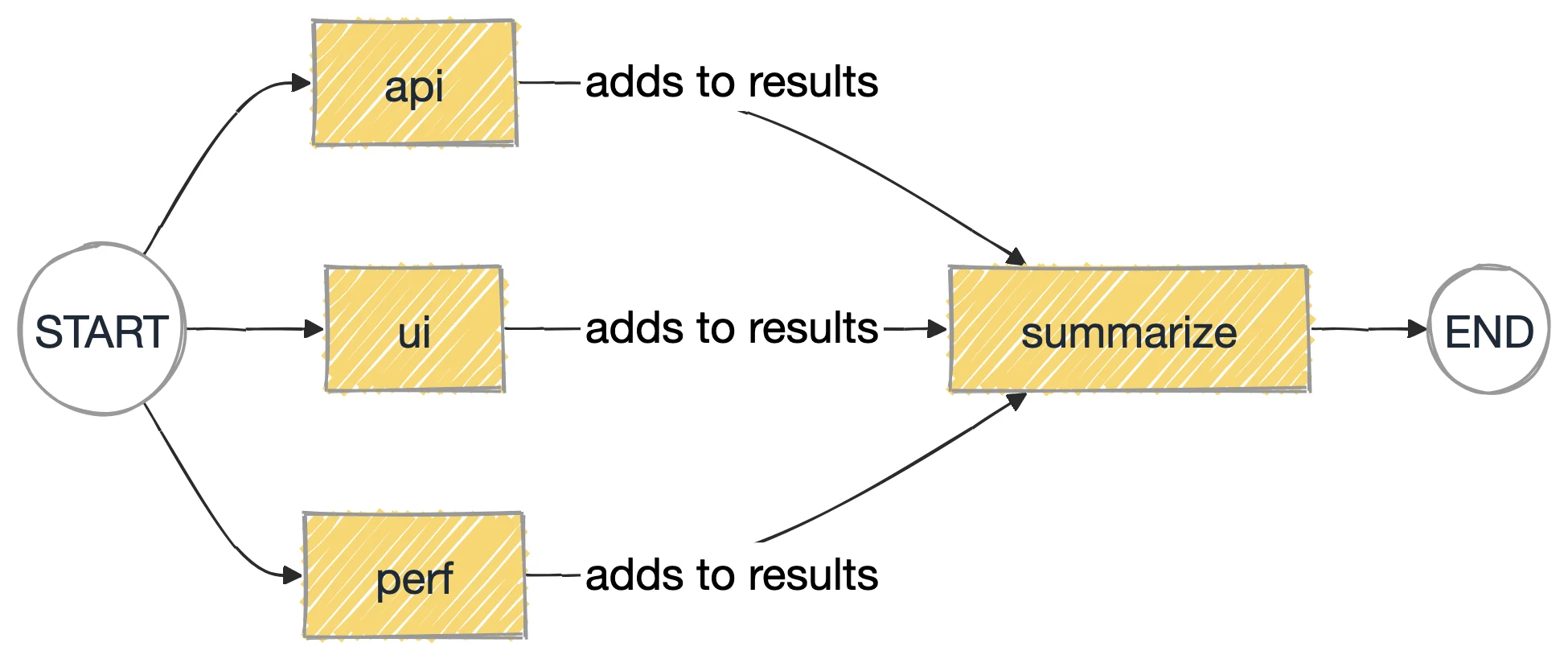
START fan out: api, ui and perf run in the same step.summarize fan in: it waits for all three before it runs.Annotated[list[str], operator.add] tells LangGraph to concatenate parallel writes. Without a reducer two writers in one step is an error.summarize has no type hint on purpose: LangGraph reads a node's type hint as its input schema.cd chapter_18_LangGraph/src/chapters
python 005_Parallel_Reducer.py api: 42/42 passed
perf: p95 380ms (budget 500ms)
ui: 118/120 passed
3 suites reported
Same graph WITHOUT the reducer:
InvalidUpdateError: At key 'results': Can receive only one value per step. Use an Annotated key to handle multiple values.Work in chapter_18_LangGraph/src/chapters. Change one thing, run it, and compare with the expected result.
Add a fourth suite that returns {"results": ["security: 0 high findings"]}.
4 suites reported, and the new line appears in results.Remove the reducer from State and run.
InvalidUpdateError: At key 'results': Can receive only one value per step. Use an Annotated key to handle multiple values.The nodes were added as api, ui, perf. In what order do the results come back?
The exact file from the course repo, plus the output it printed when this page was written.
"""005 - Parallel branches and reducers.

Three check suites fan out from START and run in the same step. They all write
to `results`. Without a reducer, LangGraph refuses: two writers, one key, which
one wins? Annotated[list, operator.add] says "append, don't overwrite".
"""
import operator
from typing import Annotated, TypedDict

from langgraph.errors import InvalidUpdateError
from langgraph.graph import END, START, StateGraph


class State(TypedDict):
    results: Annotated[list[str], operator.add]   # reducer: concatenate
    summary: str


def api_checks(state):  return {"results": ["api: 42/42 passed"]}
def ui_checks(state):   return {"results": ["ui: 118/120 passed"]}
def perf_checks(state): return {"results": ["perf: p95 380ms (budget 500ms)"]}


def summarize(state) -> dict:   # untyped: LangGraph reads node hints as input schemas
    return {"summary": f"{len(state['results'])} suites reported"}


def build(state_cls):
    b = StateGraph(state_cls)
    for name, fn in [("api", api_checks), ("ui", ui_checks), ("perf", perf_checks)]:
        b.add_node(name, fn)
        b.add_edge(START, name)          # fan-out: three edges from START
        b.add_edge(name, "summarize")    # fan-in: summarize waits for all three
    b.add_node("summarize", summarize)
    b.add_edge("summarize", END)
    return b.compile()


class StateNoReducer(TypedDict):
    results: list[str]                    # no reducer on purpose
    summary: str


if __name__ == "__main__":
    out = build(State).invoke({"results": [], "summary": ""})
    for line in out["results"]:
        print(" ", line)
    print(" ", out["summary"])

    print("\nSame graph WITHOUT the reducer:")
    try:
        build(StateNoReducer).invoke({"results": [], "summary": ""})
    except InvalidUpdateError as e:
print(" InvalidUpdateError:", str(e).splitlines()[0]) api: 42/42 passed
perf: p95 380ms (budget 500ms)
ui: 118/120 passed
3 suites reported
Same graph WITHOUT the reducer:
InvalidUpdateError: At key 'results': Can receive only one value per step. Use an Annotated key to handle multiple values.