The Testing Academy · Masterclass · QA Automation
BMAD Method for QA.
Use specialized workflows to connect product intent, risk-based test design, ATDD, automation, NFR evidence, traceability, and a defensible release recommendation.
Before you begin
Bring one epic and its real risks.
Use a synthetic login and lockout epic with owned requirements. The method structures collaboration; it cannot invent business impact, approve risk, or replace engineering evidence.
Open the first lesson- Runtime
- Node.js 20.12+, Python 3.10+, uv, npm, and Git.
- Project
- A disposable BMAD V6 workspace and one synthetic epic.
- QA skills
- Risk analysis, test design, automation, CI, and review basics.
- Ownership
- Product, architecture, security, and QA decision owners.
Part 1 · Foundations
Map the Method to QA Work
Understand lifecycle artifacts, installation, handoffs, and the difference between fast built-in E2E generation and enterprise test architecture.
Lifecycle, Agents, Workflows, and Artifacts
Connect specialized roles through owned, versioned, and reviewable artifacts.
1.2Install BMAD V6 and Inspect the Workspace
Install the current V6 method and audit the generated project surface.
1.3Requirements, Architecture, Stories, and QA Handoffs
Preserve intent, constraints, observability, and ownership across handoffs.
1.4Built-In QA Versus Test Architect Enterprise
Choose fast E2E generation or TEA's risk-and-gate model deliberately.
The operating map
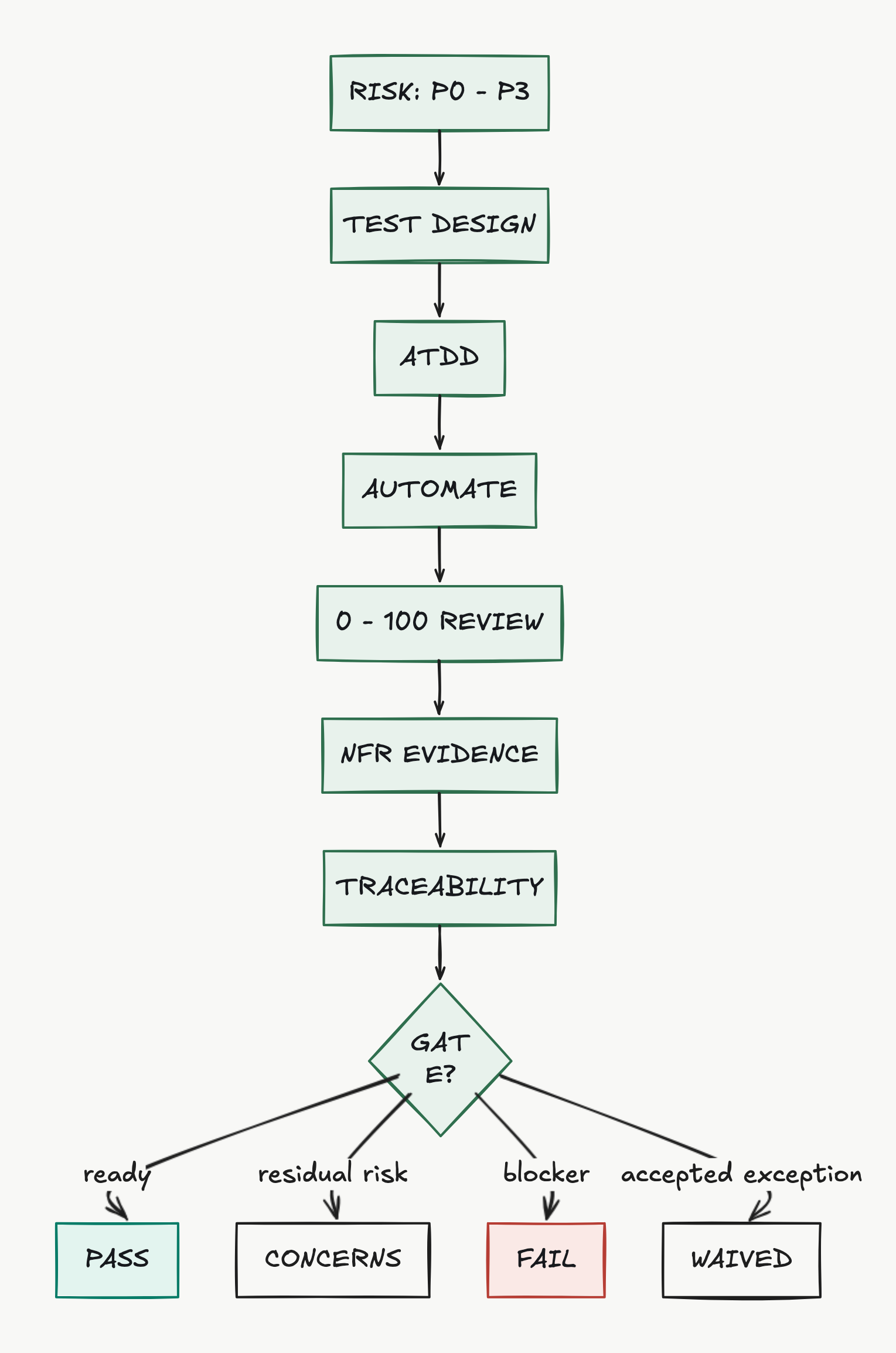
Risk travels all the way to the gate.
TEA connects P0-P3 test design, ATDD, automation, review, NFR evidence, and traceability to an explicit PASS, CONCERNS, FAIL, or WAIVED recommendation.
Part 2 · Test architecture
Design a Risk-Based Test System
Prioritize P0-P3 evidence, establish framework and CI foundations, write ATDD first, and review automation quality before scaling suites.
P0-P3 Risk Assessment and Test Design
Allocate test depth and timing from owned P0-P3 risk decisions.
2.2Test Framework and CI Setup
Treat framework, data, reports, retries, and CI lanes as contracts.
2.3ATDD Before Implementation
Create reproducible, requirement-linked red evidence before implementation.
2.4Test Automation and 0-100 Review
Automate approved risks, then score quality without hiding blockers.
Completion evidence
Finish with artifacts another SDET can audit.
A complete BMAD QA engagement leaves risk, coverage, evidence, review findings, residual concerns, and the gate owner visible in version-controlled artifacts.
{
  "course": "bmad-method-masterclass",
  "artifacts": 4,
  "deterministic_check": true,
  "human_review": "required"
}Part 3 · Governance
Make Release Evidence Defensible
Audit NFRs, trace critical requirements to evidence, choose the right engagement model, and issue an explicit gate recommendation with residual risk.
NFR Evidence for Performance, Security, and Reliability
Audit NFR claims with thresholds, artifacts, environments, owners, and limits.
3.2Traceability and PASS, CONCERNS, FAIL, or WAIVED Gates
Link current evidence to an explicit, owned release-gate outcome.
3.3Greenfield, Brownfield, and TEA Lite Engagements
Tailor TEA depth to project timing, debt, criticality, and capacity.
3.4Capstone: Carry One Login Epic Through TEA
Run a compact TEA lifecycle from P0 risk to challenged gate decision.
Source of truth
Current product behavior, not remembered shortcuts.
The curriculum was checked against official documentation and current source code where available. The lessons page contains the complete source list and implementation caveats.
Open all primary sources- BMAD Method Repository
- Current V6 source, installation, prerequisites, and project structure.
- BMAD Documentation
- Official method concepts and workflow guidance.
- BMAD Testing Reference
- Built-in QA workflow, TEA distinction, patterns, and decision guidance.
- Test Architect Enterprise
- Current TEA module source and workflow definitions.